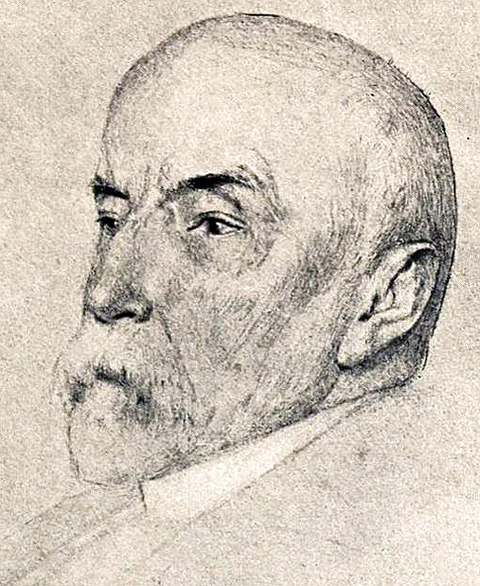
The arc of Henry Brooks Adams’s life was arguably predetermined before his birth, buttressed by the towering legacies of two U.S. Presidents, set securely atop the cornerstones of wealth and social position. Henry himself noted this advantage in the first chapter of his The Education of Henry Adams. “Probably no child born in the year held better cards than he.” An elderly Adams later opined, “Whether life was an honest game of chance, or whether the cards were marked and forced, he could not refuse to play his excellent hand. Whatever was peculiar about him was education, not character, and came to him, directly and indirectly, as the result of that eighteenth-century inheritance, which he took with his name.”
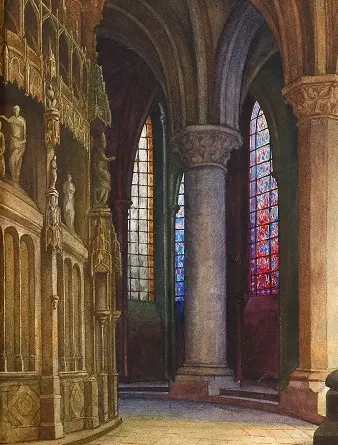
Henry, a diminutive man, was a Harvard graduate, an intellectual snob, a bigot, an anti-Semite, a consummate political insider, and a social maven – the archetypal American-Victorian male of high breeding: a Boston Brahmin. His professional persona was one of a pedagogical historian and an erstwhile political operative. He was conservative yet progressive, overbearing but submissive, and like his windows at Chartres, translucent and polychromatic, yet inscrutable and puzzling. He could be painfully honest in private but unabashedly artful in public.
In sum, Adams was an enigma, a riddle wrapped in mystery.
Adams’s wealth and family ties offered him many Gilded Age acquaintances but few close friends. Adams was wealthy, even by today’s standards ($1.5MM/yr. in 2013 dollars), and with the fundamental demands of life a fait accompli, he immersed himself in the finest of life’s offerings: traveling the globe, hobnobbing with Washington’s power elite, and plying his writing craft, when and where he pleased. Henry was an Anglophile, a Francophile, and an enigmatic ex-patriot who each year divided his time between Paris and Washington D.C. or traveling to some exotic, far-flung corner of the globe.
Henry built his professional and literary reputation on a solid intellectual capacity, an inquiring, ambitious mind, a love of science and archeology, but above all, political and socio-economic history. Adams was a prolific letter writer, as attested to by his more than 1,500 remaining letters (Henry destroyed countless others himself). His writings varied between stiff rhetorical histories and lively, intimate, conversational letters. So successful was Henry at his craft that his History of the United States of America During the Administrations of Jefferson and Madison (History) was heralded as “the greatest prose masterpiece of non-fiction in America in the nineteenth century,” and his posthumously published, The Education of Henry Adams (Education), received the 1919 Pulitzer Prize for Biography or Autobiography.